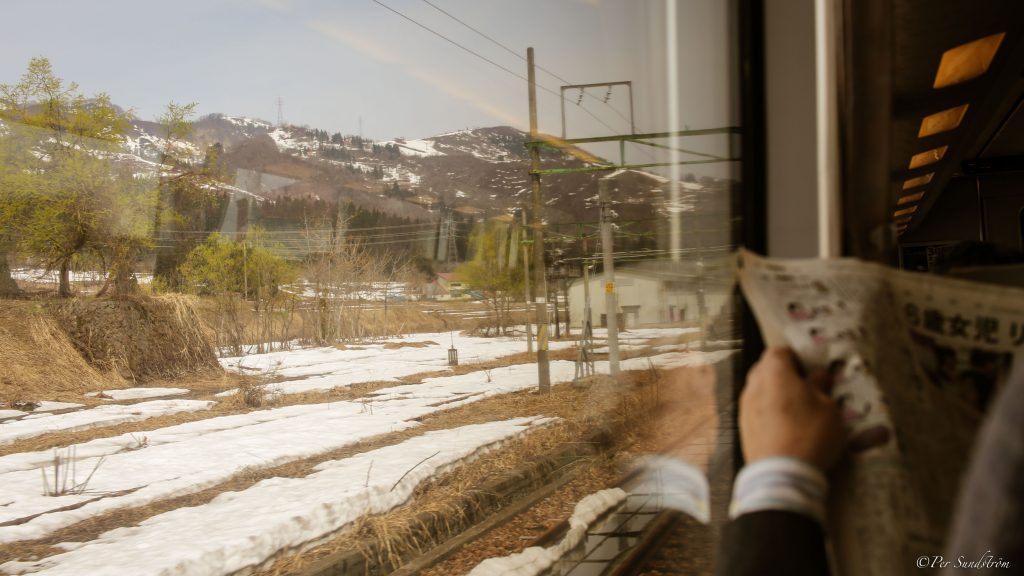
2014, April 27 | We set out from Tokyo, heading for Ishikawa Prefecture—a region on the west coast of the main island, Honshu. The train travels through tunnels, across bridges resting on massive concrete foundations, and at times alongside wide, traffic-free highways that are likewise built upon vast amounts of concrete. Our destination is Kanazawa, the capital city of Ishikawa Prefecture.
I’m thinking about the book I just read: "Japan: A Reinterpretation". A brooding account. An American journalist named Patrick Smith writes about a forgotten country—brutally industrialized, erased. The book is so depressing that I can’t bring myself to finish it.
I assume this is the country we are heading to.
We come out on the western side of the Japanese Alps. It's April and the snow is melting. Rice fields and tightly packed houses thunder by. Here the communities are small and look like they often do in Japan: old wooden houses with fragile facades, new concrete boxes - functional, cheap and strong. They are communities that are about to disappear. I read in the Japan Times about a think-tank that predicts that a thousand small towns and villages will lack fertile women within three decades.
We get off the train in Toyama and rent a car, continuing north to the Noto Peninsula; we pass rice fields and drive all the way to the town of Wajima. There, we look out over the Sea of Japan. On the other side lies North Korea, out of sight. It is raining.
We spend the night by the sea; we sleep, wake up, eat a magnificent breakfast, and gaze out over the calm water, reflecting. This is the back side—the side facing the Asian mainland. In Smith’s description, it is the backwater left behind as Tokyo and Osaka colonize the rest of Japan. This process unfolded during the economic miracle that had to take place after American B-29s had bombed Japan’s key cities to rubble and forced the empire into submission. Japans viktiga städer till grus, och tvingat imperiet till underkastelse.
And so it goes, writes Smith. Able-bodied men and their wives are sent to Japan’s "front"—the eastern side, facing the Pacific and the United States. In exchange, shrinking communities receive concrete and high-speed trains. The war is lost, yet the world is to be invaded by Japanese products, with strong backing from the occupying power. For Japan is soon forgiven and receives development aid to become a powerful US bastion against Mao Zedong and, later, Ho Chi Minh.
We drive south along an endless sandy beach, leaving the Noto Peninsula. Our destination is Kanazawa—a city the size of Gothenburg, known for, among other things, porcelain production and lacquerware.
It is a fascinating place—once a powerhouse in the Japan of Smith’s era, back when rice was the most reliable currency. Thanks to its fertile soil, Ishikawa was Japan’s wealthiest vassal state. Wealthiest of all was the Maeda samurai family, who ruled the province for three hundred years. Only the ruling Tokugawa clan is said to have been wealthier.
Kanazawa was a feudal domain. The Maeda family did not have to toil in the rice fields, as they owned the land, its produce, and the people living there. In feudal Japan—just a few generations back—commoners did not even have the right to bear a surname; they were regarded as the collective property of landowners. The Maedas’ professional army—the samurai—maintained law and order.
In this respect, it was not unlike feudal Europe. Niccolò Machiavelli could have worked there as an advisor to the Maeda family, putting into practice his fundamental principle: that a ruler must ruthlessly do whatever is necessary to retain power, yet to avoid being hated by the people.
We arrive in the rain to carry out the three-part plan: See the Maeda family fortress, the city's old Nagamachi samurai district, and visit Kenroku-en, one of Japan's three greatest gardens.
Photos from the trip are available here >>
*
perzun.se